











FAQs
High resolution oscilloscopes use higher-resolution ADCs and advanced signal processing technologies to improve signal fidelity. By increasing the number of measurable voltage levels, they can reduce quantization effects and display smoother waveforms. This allows engineers to distinguish actual signal behavior from unwanted measurement artifacts.
When selecting a high resolution oscilloscope, consider resolution, bandwidth, sampling rate, channel count, memory depth, and analysis functions. The ideal instrument should match your signal characteristics and testing requirements. UNI-T offers a range of high resolution oscilloscopes designed for laboratory research, product development, and industrial testing applications.
A high resolution oscilloscope uses advanced analog-to-digital conversion technology to capture waveforms with greater vertical accuracy than conventional oscilloscopes. Compared with standard 8-bit models, high resolution oscilloscopes typically provide 12-bit or higher resolution, allowing users to detect smaller voltage changes and low-level signal details. UNI-T High Resolution Oscilloscopes help engineers perform precise waveform analysis in power electronics, sensor testing, and research applications.
Resolution determines how accurately an oscilloscope converts analog signals into digital waveforms. Higher resolution allows smaller signal variations to be displayed and measured more clearly. This is especially important when analyzing low-noise circuits, power supply ripple, sensor outputs, or other precision signals. UNI-T High Resolution Oscilloscopes provide enhanced waveform visibility for improved measurement confidence.
The main advantages include improved measurement accuracy, reduced quantization noise, better waveform clarity, and enhanced visibility of low-amplitude signals. High resolution oscilloscopes can reveal waveform details that may be difficult to identify on standard oscilloscopes. UNI-T solutions help engineers perform more reliable testing, troubleshooting, and validation in demanding applications.
High resolution oscilloscopes are widely used in power electronics, battery research, semiconductor testing, industrial automation, automotive electronics, sensor development, and scientific laboratories. Their ability to capture subtle waveform variations makes them suitable for applications requiring precise signal analysis and troubleshooting.
The required resolution depends on the signal being measured. For general debugging, 8-bit resolution may be sufficient. However, applications involving small voltage changes, low-level noise analysis, or precision power measurements often benefit from 12-bit or higher resolution. UNI-T High Resolution Oscilloscopes offer enhanced acquisition performance for these demanding measurement tasks.
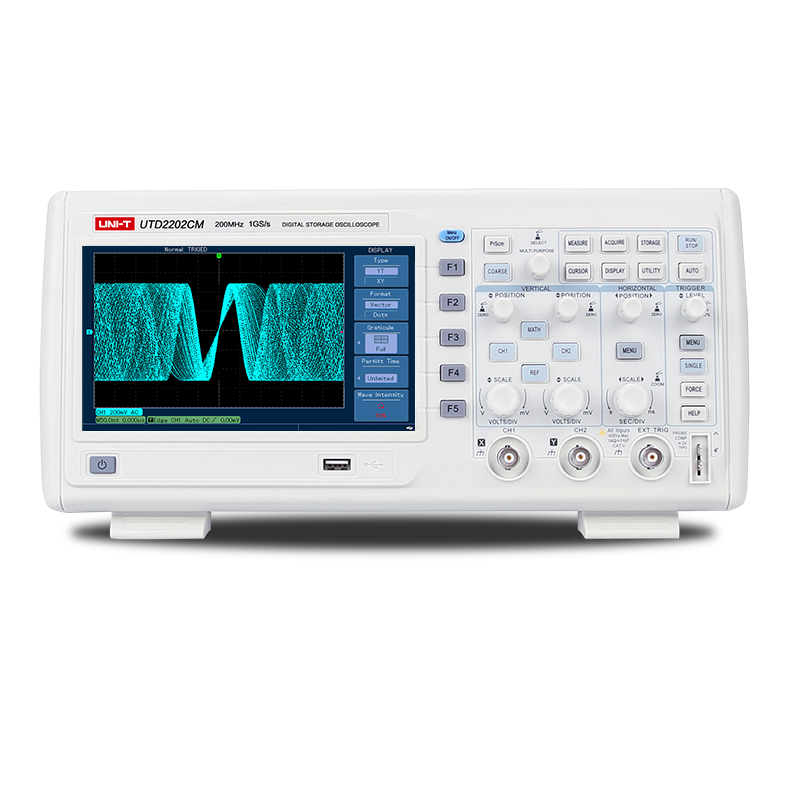
Analog oscilloscopes display signals directly in real time but cannot store or process data. Digital oscilloscopes sample and store the signal, enabling measurement, math, and analysis—the mainstream type today. Mixed signal oscilloscopes (MSOs) add digital logic channels alongside analog channels, so you can view and correlate analog waveforms with digital buses on the same time base. UNI-T’s lineup includes both digital storage and mixed signal oscilloscopes to suit either workflow.
The primary difference between an MSO (Mixed Signal Oscilloscope) and a UPO (Universal Performance Oscilloscope) is digital signal analysis capability. An MSO combines traditional analog waveform measurement with up to 16 digital logic channels, allowing users to capture and correlate analog and digital signals simultaneously. This makes it ideal for debugging embedded systems, microcontrollers, and serial buses such as SPI, I²C, UART, and CAN. A UPO focuses on high-performance analog measurements and is often a more cost-effective choice for users who only need to analyze analog signals. Choose a UNI-T MSO for mixed-signal debugging and protocol analysis, or a UNI-T UPO for efficient analog testing and troubleshooting.
To choose the right oscilloscope, start from your signal: identify its highest frequency, then apply the 5× bandwidth and sample-rate rules. Next decide how many channels you need, whether you require digital channels (MSO) or serial decoding, and how much record length your captures demand. Finally weigh portability, display, and budget. Matching specifications to the real signal prevents missed glitches and costly rework—and UNI-T’s oscilloscope range is organized by bandwidth and channel count to help you narrow the choice.