











FAQs
Yes. Many DC power supplies can be used to simulate battery output by providing stable and adjustable DC voltage levels. This allows engineers to evaluate products without using physical batteries during development and testing. Battery simulation is commonly used in consumer electronics, automotive electronics, IoT devices, and power management applications where consistent and repeatable power conditions are required.
Sensitivity determines how well an analyzer can detect low-level signals, while dynamic range describes its ability to measure weak signals in the presence of stronger ones. Higher sensitivity and wider dynamic range improve measurement reliability and make it easier to identify small signals, interference, harmonics, and spurious emissions. These characteristics are particularly important in modern RF and wireless testing applications.
Yes. Spectrum analyzers are widely used to evaluate wireless communication signals such as Wi-Fi, Bluetooth, cellular, IoT, and other RF transmissions. They can help measure signal strength, occupied bandwidth, channel behavior, and interference levels. Depending on the model and available functions, UNI-T spectrum analyzers can support a variety of wireless testing and troubleshooting tasks.
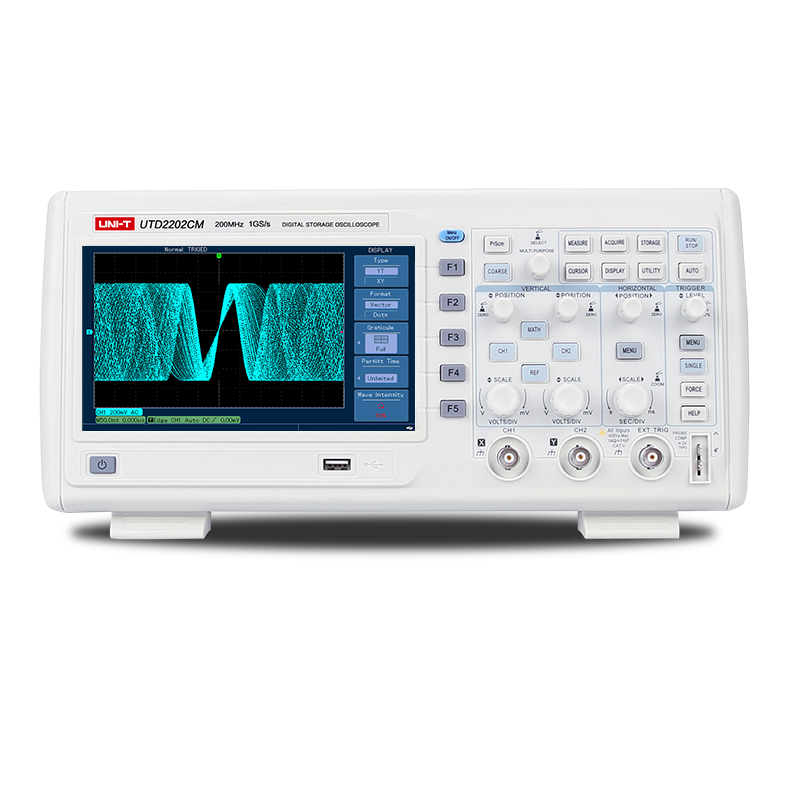
A spectrum analyzer displays signals in the frequency domain, showing how signal power is distributed across frequencies, while an oscilloscope displays signals in the time domain, showing voltage changes over time. Both instruments provide valuable but different perspectives of a signal. Engineers often use UNI-T spectrum analyzers and oscilloscopes together to gain a more complete understanding of system performance.
A DC power supply is an instrument that provides stable direct current (DC) voltage and current to power electronic devices, circuits, and systems. Unlike AC power sources, a DC power supply delivers constant output that can be adjusted to meet specific testing or development needs. UNI-T DC power supplies are widely used in laboratories, manufacturing, education, maintenance, and product development environments where reliable and accurate power delivery is essential.
A programmable DC power supply allows users to control voltage, current, and output parameters through a front panel, computer interface, or automated test system. This capability is particularly valuable for repetitive testing, production environments, and R&D applications. UNI-T programmable DC power supplies help improve testing efficiency by enabling automated test sequences, remote operation, data logging, and precise output control.
A signal analyzer is used to measure, visualize, and characterize electronic and RF signals. It can help evaluate signal power, frequency, bandwidth, modulation quality, and spectral characteristics. UNI-T signal analyzers are commonly used in wireless communication development, RF testing, product validation, education, and maintenance applications where accurate signal analysis is essential.
A spectrum analyzer focuses on measuring signal power across a frequency range and is widely used for spectrum monitoring, interference detection, and RF troubleshooting. A signal analyzer typically includes additional analysis capabilities, such as modulation and vector signal measurements, allowing deeper evaluation of communication signals. UNI-T offers solutions that support both spectrum analysis and advanced signal characterization requirements.
Spectrum and signal analyzers are used across a variety of industries, including wireless communications, electronics manufacturing, EMC testing, automotive electronics, aerospace, education, and IoT development. They help engineers verify signal quality, identify sources of interference, evaluate transmitter performance, and ensure compliance with technical standards. UNI-T analyzers support both laboratory and field-testing environments.
Selecting the right analyzer depends on your testing requirements, including frequency range, measurement accuracy, signal type, and required analysis functions. Users should also consider sensitivity, dynamic range, phase noise, and portability. UNI-T provides spectrum and signal analyzers designed for applications ranging from basic RF measurements to advanced wireless communication testing.