











FAQs
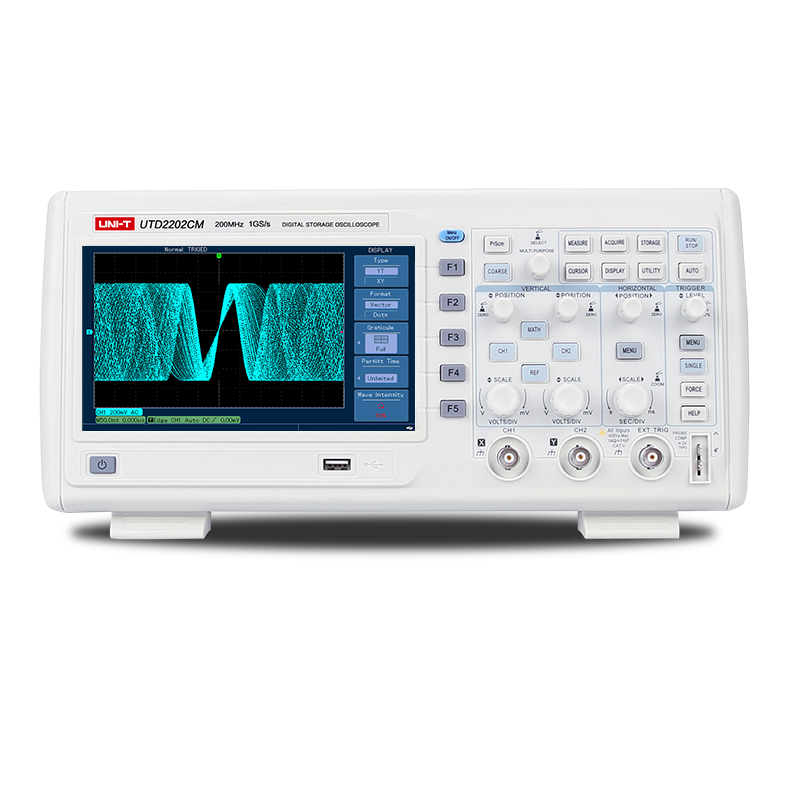
UNI-T High Resolution Oscilloscopes combine precise waveform acquisition, advanced analysis capabilities, and user-friendly operation in a cost-effective solution. Designed for engineers, researchers, and educators, they deliver accurate signal visualization and reliable measurement performance across a wide range of electronic testing applications.
Yes. High resolution oscilloscopes can capture small voltage fluctuations, switching ripple, and transient events more clearly than standard oscilloscopes. This helps engineers evaluate power quality, optimize converter performance, and identify efficiency issues. UNI-T High Resolution Oscilloscopes provide detailed waveform visibility for power electronics design and validation.
Bandwidth determines the highest signal frequency an oscilloscope can accurately measure, while resolution determines how precisely signal amplitudes can be displayed. Both parameters are important but serve different purposes. UNI-T High Resolution Oscilloscopes combine advanced resolution with strong signal acquisition performance to support accurate waveform analysis.
High resolution oscilloscopes use higher-resolution ADCs and advanced signal processing technologies to improve signal fidelity. By increasing the number of measurable voltage levels, they can reduce quantization effects and display smoother waveforms. This allows engineers to distinguish actual signal behavior from unwanted measurement artifacts.
When selecting a high resolution oscilloscope, consider resolution, bandwidth, sampling rate, channel count, memory depth, and analysis functions. The ideal instrument should match your signal characteristics and testing requirements. UNI-T offers a range of high resolution oscilloscopes designed for laboratory research, product development, and industrial testing applications.
A high resolution oscilloscope uses advanced analog-to-digital conversion technology to capture waveforms with greater vertical accuracy than conventional oscilloscopes. Compared with standard 8-bit models, high resolution oscilloscopes typically provide 12-bit or higher resolution, allowing users to detect smaller voltage changes and low-level signal details. UNI-T High Resolution Oscilloscopes help engineers perform precise waveform analysis in power electronics, sensor testing, and research applications.
Resolution determines how accurately an oscilloscope converts analog signals into digital waveforms. Higher resolution allows smaller signal variations to be displayed and measured more clearly. This is especially important when analyzing low-noise circuits, power supply ripple, sensor outputs, or other precision signals. UNI-T High Resolution Oscilloscopes provide enhanced waveform visibility for improved measurement confidence.
The main advantages include improved measurement accuracy, reduced quantization noise, better waveform clarity, and enhanced visibility of low-amplitude signals. High resolution oscilloscopes can reveal waveform details that may be difficult to identify on standard oscilloscopes. UNI-T solutions help engineers perform more reliable testing, troubleshooting, and validation in demanding applications.
High resolution oscilloscopes are widely used in power electronics, battery research, semiconductor testing, industrial automation, automotive electronics, sensor development, and scientific laboratories. Their ability to capture subtle waveform variations makes them suitable for applications requiring precise signal analysis and troubleshooting.
The required resolution depends on the signal being measured. For general debugging, 8-bit resolution may be sufficient. However, applications involving small voltage changes, low-level noise analysis, or precision power measurements often benefit from 12-bit or higher resolution. UNI-T High Resolution Oscilloscopes offer enhanced acquisition performance for these demanding measurement tasks.